When your workplace needs a chemical decontamination solution
A chemical decontamination solution is needed the moment a hazardous substance makes contact with skin, clothing, or a work surface – a splash from a container being poured, a leak during maintenance, or contact while handling samples in a lab. In these situations, decontamination sits alongside personal protective equipment and engineering controls as the last line of defense before the chemical can cause further tissue damage or spread to other people and equipment.
Speed matters more than anything else: the longer a corrosive or toxic substance stays in contact with the skin, the greater the risk of burns, absorption, or systemic poisoning. This is why workplaces handling acids, alkalis, solvents, or reactive chemicals plan their response around two elements within arm’s reach of the work area – copious water rinsing, and a dedicated chemical decontamination solution such as Plum BodyNeutrAll.
Plum BodyNeutrAll – a chemical decontamination solution for workplaces
Plum BodyNeutrAll is a portable decontamination solution formulated to neutralize or bind hazardous chemicals on uninjured skin, clothing, and surfaces directly at the scene of an accident. It is certified as a Class I medical device under EU Regulation 2017/745 and is registered for use across the EU.
The solution works through several complementary mechanisms rather than a single active ingredient. An ascorbic acid component reduces strongly oxidizing substances, such as chlorine, hypochlorite, and hydrogen peroxide, to compounds that are no longer reactive. An amino acid buffer neutralizes strong acids and alkalis, while glycine binds formaldehyde and phenols. Calcium chloride precipitates fluoride ions as insoluble calcium fluoride, which also plays a role in decontamination after hydrofluoric acid exposure (see below). Glycerol and polyethylene glycol help dissolve organic solvents.
A practical benefit of this combination is that a single saturating application is usually sufficient. Unlike products that call for continuous rinsing, BodyNeutrAll only needs the affected area to be thoroughly wetted and left for around 30 seconds. A colour change from clear to red confirms that oxidizing agents in the treated area have been inactivated.
BodyNeutrAll is intended for uninjured skin, clothing, and surfaces. It should not be used in the eyes, on mucous membranes, or on broken skin, and it is not suitable for accidents involving concentrated sulfuric acid – these cases call for flushing with water or a sterile eyewash solution instead.
Decontamination after exposure to hazardous chemicals
The right decontamination response depends on which chemical is involved. As part of a wider chemical burns first aid plan, Plum BodyNeutrAll addresses a broad group of hazard classes — strong acids and alkalis, oxidizing agents, formaldehyde, phenols, organic solvents, and hydrofluoric acid — but the specific steps a workplace takes, and the equipment it keeps on hand, should always follow its own chemical risk assessment and safety data sheets.
Hydrofluoric acid and fluoride exposure
Hydrofluoric acid is used across industries such as mining, semiconductor manufacturing, glass production, and petrochemical processing, and it requires particular care because fluoride ions can continue to penetrate and damage tissue well after the initial contact, sometimes without immediate pain. Hydrofluoric acid burn treatment is a medical matter: any exposure calls for immediate professional medical attention, regardless of which decontamination or first aid product has been used on site.
Because of this, hydrofluoric acid exposure is often searched for alongside the term hydrofluoric acid antidote. In practice, the products used at this stage are more accurately described as decontamination and topical first aid measures rather than a pharmaceutical antidote. Plum BodyNeutrAll contains calcium chloride, which precipitates fluoride as insoluble calcium fluoride and is part of how the product decontaminates uninjured skin, clothing, and surfaces after hydrofluoric acid or fluoride exposure. This is a different substance from calcium gluconate gel, a topical first aid product commonly kept alongside hydrofluoric acid and massaged into affected skin after initial rinsing. Workplaces handling hydrofluoric acid typically plan for both a decontamination solution and, where their risk assessment calls for it, a topical calcium gluconate product, as part of a wider emergency response procedure defined with occupational health and safety advisors.
Acids, alkalis and other hazardous substances
For strong acids and alkalis, oxidizing agents, formaldehyde, phenols, and organic solvents, BodyNeutrAll is designed to be applied directly to affected, uninjured skin, clothing, or surfaces at the scene of the incident. As with any chemical exposure, the safety data sheet for the specific substance involved should guide the response, and exposed individuals should be assessed by a medical professional when the safety data sheet or workplace procedure calls for it.
Choosing the right Plum BodyNeutrAll solution
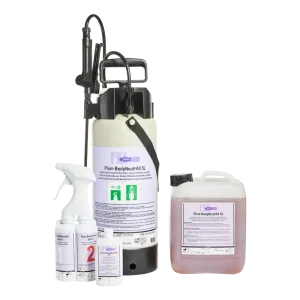
Plum BodyNeutrAll is available in three formats, sized for different exposure scenarios and how the product will be stored on site.
- Mobile shower, 5 L — a refillable sprayer for larger-scale decontamination, suited to production areas and workshops where a full-body or multi-person response may be needed. Can be mounted in the optional Plum Cabinet for protected, visible storage.
- Spray, 600 ml — a double-chamber pump spray covering up to roughly 6 m² or three people, a practical size for smaller workstations, labs, or vehicles.
- Pocket solution, 100 ml — a pocket-sized bottle covering approximately 1 m² or one arm’s length, intended to be carried by individuals working away from a fixed decontamination point.
Many workplaces combine formats: a mobile shower at a central decontamination station, with pocket solutions carried by staff working in the field or at a distance from fixed first aid provisions.
Frequently asked questions about chemical decontamination
What is Plum BodyNeutrAll used for?
Plum BodyNeutrAll is a portable chemical decontamination solution for uninjured skin, clothing, and surfaces exposed to hazardous substances such as strong acids, alkalis, oxidizing agents, formaldehyde, phenols, organic solvents, and hydrofluoric acid.
Is Plum BodyNeutrAll a calcium gluconate gel?
No. Plum BodyNeutrAll contains calcium chloride, which precipitates fluoride as insoluble calcium fluoride, rather than calcium gluconate. Calcium gluconate gel is a separate topical first aid product used specifically for hydrofluoric acid skin exposure. The two are not interchangeable, and a workplace risk assessment should determine which products belong in its emergency response kit.
Can Plum BodyNeutrAll be used on the eyes?
No. Plum BodyNeutrAll is not suitable for the eyes or mucous membranes. Eye exposure to hazardous chemicals should be treated with a dedicated eyewash solution, followed by medical attention.
Does hydrofluoric acid exposure always need medical attention?
Yes. Hydrofluoric acid can continue to damage tissue after the initial contact and may cause delayed symptoms. Any exposure should be treated as a medical emergency, with professional medical attention sought immediately, regardless of which decontamination product was used on site.
How long does Plum BodyNeutrAll last in storage?
Plum BodyNeutrAll has a shelf life of at least three years from the date of manufacture, which fits standard first aid restocking cycles.